
The United States has long been a global leader in industrial production, and understanding the evolution of the manufacturing industry provides valuable insight into how technology, labor, and economic policy have shaped modern America. From small workshops in the 18th century to massive automated factories today, manufacturing has been at the heart of economic growth, innovation, and global competitiveness.
This article explores the transformation of U.S. manufacturing across centuries, highlighting key technological advancements, shifts in labor and management practices, and the impact of globalization. We will examine how these changes have influenced productivity, workforce dynamics, and the broader economy, providing a comprehensive overview of the evolution of the manufacturing industry in the United States.
Early Beginnings: Craftsmanship and the Pre-Industrial Era
Before the Industrial Revolution, U.S. manufacturing was primarily artisanal. Small workshops and local craftsmen produced goods by hand, relying on skill and craftsmanship rather than machinery.
Key Features of Pre-Industrial Manufacturing
- Production was labor-intensive and time-consuming
- Output was limited to local demand
- Skills were passed through apprenticeships
- Products were often customized and unique
During this era, the focus was on quality and manual precision rather than volume. Tools were simple, and raw materials were sourced locally. Understanding this period is essential to appreciate the drastic transformations that came with the industrial age.
The Industrial Revolution and Mechanization
The first major shift in the evolution of the manufacturing industry occurred during the Industrial Revolution in the early 19th century. The introduction of mechanized equipment, steam power, and assembly techniques transformed production.
Factories began to appear in urban centers, replacing small workshops. This period saw the rise of textile mills, ironworks, and early machine shops. Innovations like the cotton gin, steam engines, and mechanized looms enabled higher output and standardized products.
Impacts of Mechanization
- Increased production speed and scale
- Reduced reliance on purely manual labor
- Laid the foundation for urban industrial centers
- Introduced wage labor as a dominant employment model
Mechanization represented the first step in transforming U.S. manufacturing from a craft-based economy to an industrial powerhouse.
The Rise of Mass Production and the Assembly Line
By the early 20th century, the evolution of the manufacturing industry was marked by the adoption of mass production techniques. Henry Ford’s implementation of the moving assembly line for the Model T in 1913 exemplified this change.
Advantages of Mass Production
- Standardized parts reduced costs and simplified repairs
- Increased production speed allowed goods to reach a larger market
- Lowered consumer prices made products more accessible
- Shifted labor from skilled craftsmen to machine operators
Mass production reshaped the workforce, emphasizing repetitive tasks over traditional craftsmanship. This period also saw the growth of large corporations and the emergence of specialized industrial management practices.
Technological Advancements in the Mid-20th Century
The mid-20th century brought significant technological innovations that further accelerated the evolution of U.S. manufacturing. Electrical machinery, advanced metallurgy, and automation began to replace manual processes.
Key Developments
- Introduction of numerical control (NC) machines
- Widespread use of conveyor systems and robotics
- Expansion of chemical and plastics industries
- Growth of aerospace and defense manufacturing
These innovations improved precision, efficiency, and product complexity, allowing U.S. manufacturers to compete on a global scale. During World War II, the manufacturing sector proved its strategic importance, rapidly producing military vehicles, aircraft, and weapons with unprecedented efficiency.
Globalization and the Shift in Manufacturing Trends
From the late 20th century onward, the evolution of the manufacturing industry has been heavily influenced by globalization. The rise of international trade, outsourcing, and supply chain integration transformed both production strategies and workforce dynamics.
Effects of Globalization
- Movement of labor-intensive jobs overseas to reduce costs
- Emphasis on high-tech and value-added manufacturing in the U.S.
- Development of lean manufacturing and just-in-time production systems
- Increased competition from emerging industrial economies
Globalization reshaped the U.S. manufacturing landscape, emphasizing innovation, technology, and efficiency rather than sheer production volume. Companies had to adapt to maintain competitiveness while navigating changing global markets.
Automation and Industry 4.0
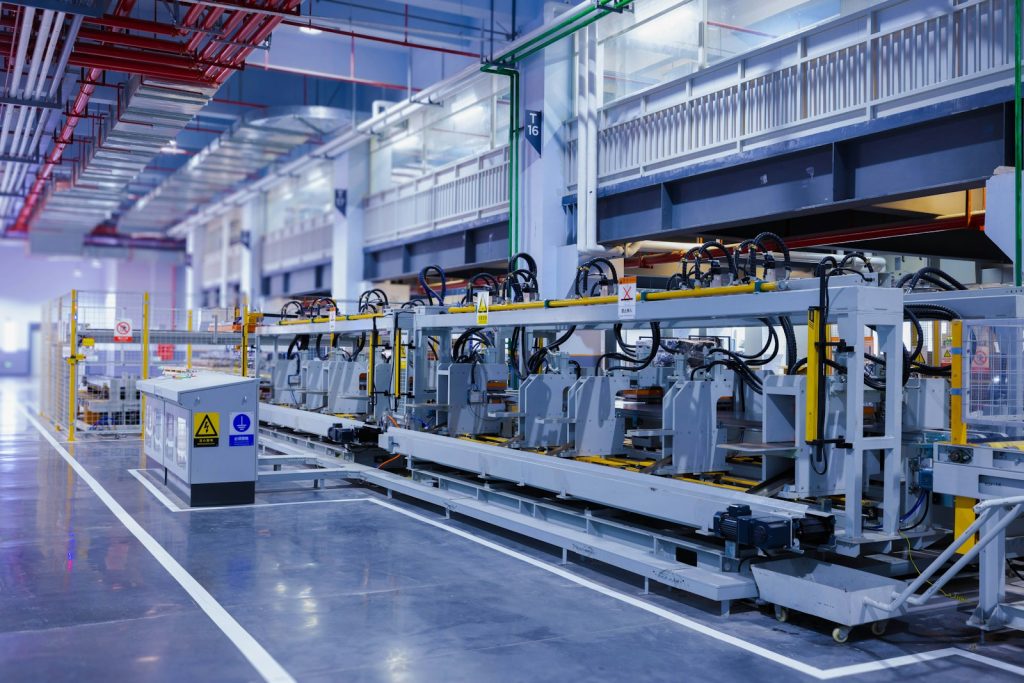
In recent decades, the evolution of the manufacturing industry has entered a new phase: Industry 4.0. This era emphasizes digital integration, smart factories, and advanced automation. Artificial intelligence, robotics, and IoT technologies are transforming production processes.
Features of Modern Manufacturing
- Use of collaborative robots (cobots) and autonomous machinery
- Real-time monitoring and predictive maintenance through IoT
- Data-driven production optimization using AI and analytics
- Advanced additive manufacturing, including 3D printing
These technologies enable highly flexible, efficient, and precise production. Modern factories can produce complex products with minimal human intervention while maintaining high quality and safety standards.
Workforce Implications
Throughout the evolution of U.S. manufacturing, workforce requirements have shifted dramatically. From skilled artisans to assembly line workers to high-tech engineers, each phase of development demanded new skills.
Key Workforce Trends
- Early industrialization: manual labor and technical apprenticeships
- Mass production: repetitive, unskilled tasks
- Automation: technical, engineering, and IT expertise
- Industry 4.0: data analysis, robotics operation, and systems integration
This evolution highlights the need for ongoing education, vocational training, and workforce adaptation to keep pace with technological advancements.
Sustainability and Environmental Considerations
Modern manufacturing increasingly incorporates sustainability and environmental responsibility. Companies are adopting cleaner energy sources, recycling initiatives, and waste reduction techniques.
Sustainable Manufacturing Practices
- Energy-efficient machinery and production lines
- Reduction of industrial waste and emissions
- Implementation of circular economy principles
- Use of renewable materials and green supply chains
Sustainability has become a defining characteristic of contemporary manufacturing, reflecting both regulatory requirements and consumer expectations.
Experience From the Field
Our team has observed firsthand the transformation of U.S. manufacturing through visits to historical industrial sites, modern factories, and advanced production facilities. Experiencing both legacy plants and cutting-edge Industry 4.0 operations highlights the contrast and continuity in the evolution of the manufacturing industry.
We have noted that successful manufacturers are those who embrace technology, invest in workforce development, and adapt processes to global market demands. These lessons demonstrate how historical innovation informs modern industrial strategy.
Conclusion
The story of the evolution of the manufacturing industry in the United States is one of innovation, adaptation, and resilience. From early artisanal workshops to the high-tech smart factories of today, manufacturing has continually reshaped the economy, workforce, and society.
Key themes include:
- Mechanization and mass production revolutionized efficiency
- Technological innovation drove precision and complexity
- Globalization reshaped production strategies and workforce needs
- Automation and digital integration define the future of manufacturing
Understanding this evolution provides insight into not only how the U.S. became a global industrial leader but also how it must continue to adapt in a rapidly changing technological and economic landscape. The journey of U.S. manufacturing is ongoing, and its ability to innovate will determine its role in the global economy for decades to come.
You May Also Like: Why Japan Has a Massive Automotive Industry: The Foundations of Global Automotive Dominance